



Tennis Elbow Relief & Rehabilitation
At The Physicare, we provide evidence-based physiotherapy, ergonomic correction, and taping support to help you recover from Tennis Elbow safely and quickly.
Tennis Elbow (Lateral Epicondylitis) is a condition caused by overuse of the forearm muscles, leading to irritation or micro-tears around the outer elbow tendon.
Our approach includes
- Accurate clinical assessment
- Pain-relief therapies
- Kinesio-taping for instant support
- Strengthening & mobility training
- Ergonomic modifications for long-term relief
- A personalized home exercise plan
Get back to pain-free work, workouts, and daily life — with the right physiotherapy care.
Common Symptoms
Why Choose Physiotherapy for Tennis Elbow?
Physiotherapy is the first-line and most effective treatment for Tennis Elbow. At The Physicare, we follow a structured, root-cause approach focusing on:
- Tissue healing
- Pain relief
- Forearm muscle balance
- Technique & ergonomic correction
- Long-term strengthening
This ensures complete recovery and minimizes the chance of recurrence.
Our Comprehensive Tennis Elbow Rehabilitation Program
1. Clinical Assessment & Diagnosis
We begin with a detailed assessment to identify the exact cause and severity of your condition, including:
- Stage of the condition (acute or chronic)
- Muscle imbalance
- Grip strength issues
- Work or sports-related mechanical faults
- Posture and ergonomic factors
- Forearm and shoulder compensations
This thorough evaluation guides a fully personalized treatment plan.
2. Pain Relief Physiotherapy Techniques
To reduce inflammation, irritation, and discomfort, we use:
- Cryotherapy
- Ultrasound therapy
- TENS / IFT
- Laser therapy
- Soft tissue release
- Trigger point therapy
- Joint mobilizations (elbow–wrist–shoulder chain)
Goal: Reduce pain, relax tight structures, and accelerate tissue healing.
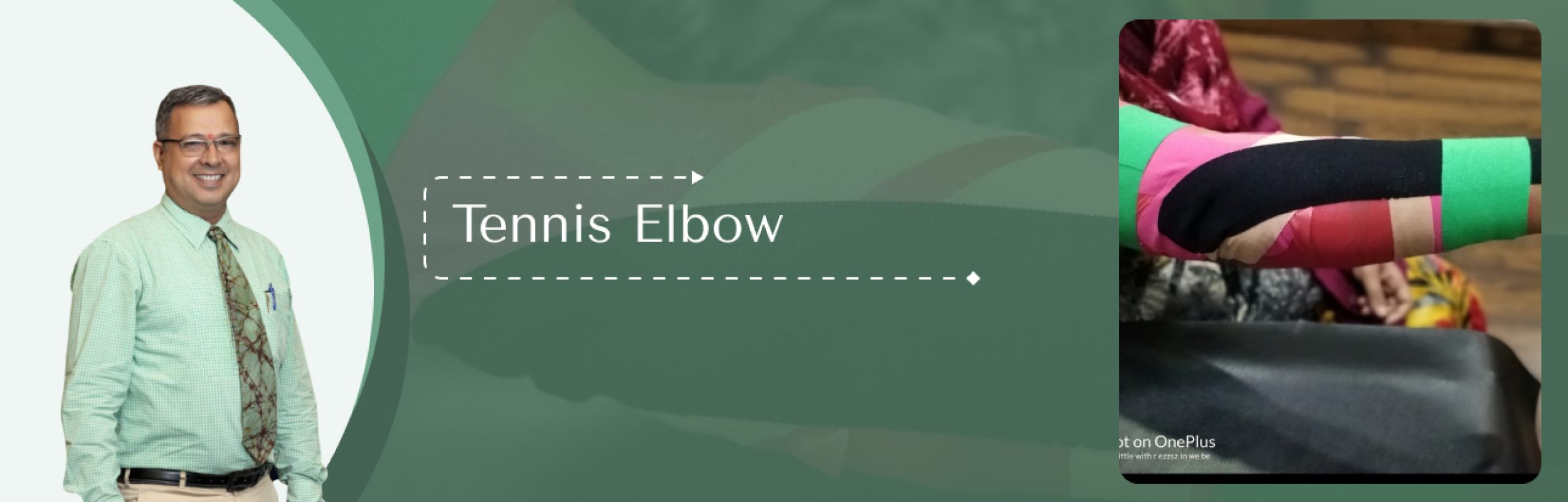
3. Taping for Tennis Elbow (Your Specialized Skill)
Kinesio-Taping or Rigid Taping is used to support and protect the injured tendon. Taping helps by:
- Reducing strain on the irritated tendon
- Offloading painful tissues
- Improving circulation
- Allowing pain-free movement
- Supporting the arm during sports or work
- Boosting confidence to use the arm normally
When do we use taping?
- During pain flare-ups
- During long hours of computer work
- For athletes during training
- For work tasks involving grip strength
Under your expertise, taping becomes a powerful bridge between pain and functional recovery.
4. Manual Therapy (Your Core Expertise)
We use specialized hands-on physiotherapy techniques such as:
- Myofascial release for wrist extensor muscles
- Cross-friction massage for the extensor tendon
- Graston / IASTM techniques
- Joint mobilizations of the elbow, wrist, and cervical spine
- Neural gliding for radial nerve irritation
These methods help:
- Reduce tissue adhesions
- Improve tendon healing
- Restore mobility
- Normalize biomechanics
5. Targeted Exercise Therapy (Most Crucial for Long-Term Recovery)
We create a structured, progressive exercise plan that includes:
Early Phase:
- Pain-free wrist extension exercises
- Isometric activation drills
- Gentle forearm stretches
Strengthening Phase:
- Eccentric wrist extensor strengthening
- Flexor–extensor muscle balancing
- Grip strengthening
- Shoulder and scapular stability work
Functional Phase:
- Activity training
- Sport-specific drills
- Workplace and posture retraining
- Return-to-work or return-to-sport planning
Exercise is the key to full recovery — and preventing future recurrence.
6. Ergonomics & Activity Modification (Your Unique Strength)
As a Preventive Physiotherapist, you help patients correct habits that strain the tendon, such as:
- Improper mouse & keyboard alignment
- Poor wrist posture during typing
- Incorrect device holding techniques
- Repetitive strain patterns
- Improper lifting technique
- High forearm load patterns
These corrections create major improvements in long-term recovery and elbow health.
7. Home Program & Follow-Up
We provide a complete home-based plan that includes:
- Daily exercise routine
- Do’s and Don’ts
- Workstation advice
- Self-release techniques
- Regular progress monitoring
This empowers patients to take control of their recovery.
When Should You Seek Help?
Seek physiotherapy if you experience:
- Pain lasting more than 7–10 days
- Difficulty gripping or lifting objects
- Pain spreading to the forearm or shoulder
- Pain during computer or desk work
- Recurring pain during sports
Early treatment prevents chronic tendon damage.
Why Choose Dr. Anil Sharma (The Physicare)?
With a strong background in:
- Ergonomics
- Workplace Physiotherapy
- Sports-Injury Management
- Taping & Manual Therapy
- Posture Correction
You offer a complete 360° recovery plan — combining immediate relief, long-term strengthening, and functional return.
Visit: The Physicare, 3/128 Karan Street, Vishwas Nagar, Shahdara, Delhi
Call/WhatsApp: +91 98111 19153


